
Most students aren't buying tools; they're burning cash on expensive paperweights that will be obsolete before junior year. Finding the best tech for students isn't about following a viral trend; it's about building a tactical ecosystem designed for academic dominance. It's exhausting to sift through social media hype that prioritizes aesthetics over actual performance, especially when you're worried your next big purchase will be a tactical error that leaves you struggling to focus.
You deserve a frictionless workflow that provides a genuine competitive edge while ensuring your hardware lasts all four years. This guide cuts through the marketing noise to show you how to maximize your ROI and reclaim your time. We've vetted the gear that actually delivers results so you can stop guessing and start performing.
We'll preview the essential 2026 gear, including the new M5 processors and curated AI research tools, that will transform your study habits into a system of high-performance output.
Key Takeaways
- Shift your mindset from passive consumption to active creation by treating every hardware purchase as a high-stakes tactical investment.
- Discover how to integrate the best tech for students into a seamless ecosystem that balances heavy-duty research with visual digital annotation.
- Protect your physical capital and mental focus by implementing silence protocols and ergonomic essentials designed for long-term academic endurance.
- Eliminate administrative friction by automating literature reviews and file management with high-performance AI tools and secure cloud ecosystems.
- Build a professional-grade kit without the premium price tag by leveraging tiered selection strategies and exclusive insider student discounts.
Stop Buying Toys: Why Student Tech is a Tactical Investment in 2026
Stop treating your backpack like a toy chest. In 2026, the gap between the academic elite and the struggling majority isn't just about effort. It's about infrastructure. The brutal reality is that mediocre gear leads to mediocre results. If your laptop lags when you have twenty research tabs open, you aren't just losing time; you're hemorrhaging focus. Focus is your most valuable currency. You can't afford to waste it on hardware that can't keep up with your brain. Consider the cost of a system crash during a final exam or a lost file right before a deadline. These aren't just inconveniences. They are preventable failures of your personal tactical setup.
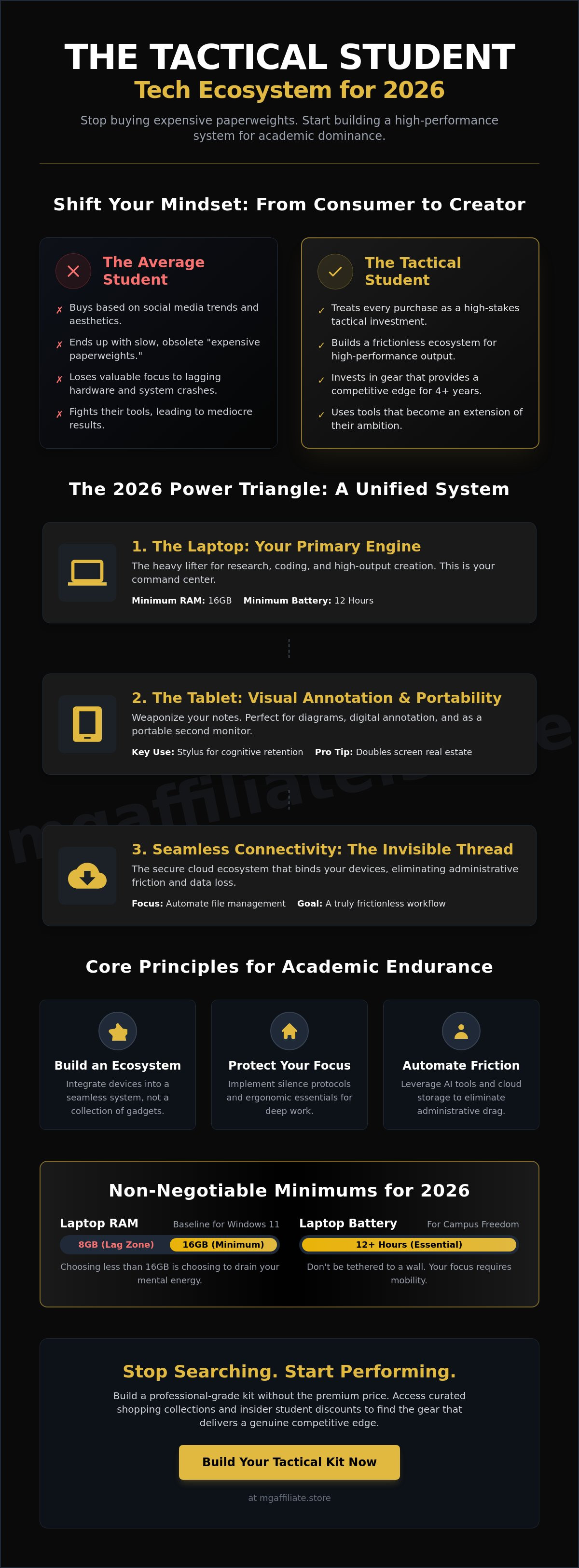
The field of educational technology has evolved beyond simple digital textbooks. It's now a performance ecosystem. The best tech for students isn't about following a viral trend or buying the thinnest chassis on the market. It's about the "Frictionless Life." This philosophy demands tools that eliminate every micro-stressor in your day. When your gear works perfectly, it disappears. You're left with nothing but your work and your goals. If you're fighting your tools, you've already lost the battle. In 2026, 16GB of RAM is the bare minimum for any student running Windows 11. Anything less is a compromise that will drain your mental energy and slow your progress.
The Shift from Consumption to Creation
Your high-end smartphone is likely your biggest academic liability. It's a consumption device designed to harvest your attention, not a tool for production. To dominate your field, you need a command center. This requires hardware that enables high-output work like complex coding, professional design, and deep data analysis. Move beyond "aesthetic" setups built for social media likes. You need a functional environment that demands deep work. If your setup doesn't facilitate creation, it's just expensive clutter. High-performance students identify the best tech for students based on output capacity, not brand hype. Your gear should be an extension of your ambition, not a distraction from it.
ROI: Calculating the Value of Your Setup
Tech ROI is the ratio of output quality to time invested. Stop scrolling through endless, conflicting reviews that lead to decision paralysis. This is why a curated shopping collection is your most effective shortcut to academic dominance. You must avoid the "cheap tax" at all costs. Buying a budget machine that becomes obsolete in eighteen months is a financial failure. It's better to buy once than to buy three times. Invest in a system that provides a competitive edge for your entire degree. You aren't just buying a laptop; you're buying insurance for your future success.
The Power Triangle: Laptops, Tablets, and Seamless Connectivity
If your workflow is fragmented, your academic output will be too. High-performance students don't just buy gadgets; they build a "Power Triangle." This consists of your laptop, your tablet, and the invisible threads of connectivity that bind them. Most students fail because they treat these as isolated purchases. You can't afford that tactical error. To secure the best tech for students, you must construct a unified system where every device serves a specific, high-value purpose without manual friction.
The Laptop: Your Primary Academic Engine
Your laptop is your heavy lifter. In 2026, 16GB of RAM is no longer a luxury; it's the baseline for Windows 11 stability. If you're settling for 8GB, you're choosing to lag. Your battery must hit the 12-hour threshold to ensure you aren't tethered to a library wall like a prisoner. For those in the Apple ecosystem, the MacBook Air M5 (2026) provides the efficiency to meet these demands. If you require raw AI processing power, the Acer Swift 16 AI with the Panther Lake processor is a top-tier choice for the best tech for students. You need the power of a workstation with the weight of a notebook for a sustainable campus carry.
The Tablet: For Visual Learners and Annotators
A tablet isn't for scrolling social media. It's for weaponizing your notes. Complex diagrams, chemical structures, and mathematical proofs are a nightmare on a keyboard. The stylus allows for a level of cognitive retention that typing simply cannot match. High-performance students use their tablets, like the iPad Air M4 or the Samsung Galaxy Tab S11 Ultra, as secondary monitors through sidecar features. This doubles your screen real estate instantly during intense research sessions. Reviewing back-to-school tech essentials confirms that the most successful setups prioritize this cross-device synergy.
Connectivity is the nervous system of your setup. In 2026, Wi-Fi 7 and high-speed USB-C hubs are non-negotiable. If your devices don't talk to each other without your intervention, your system is broken. Cloud synchronization must be invisible and instantaneous. You should be able to start a research paper on your laptop and annotate the bibliography on your tablet while walking to class. Check out our curated gear lists to find the hubs and cables that won't bottleneck your performance. Don't let a cheap cable be the single point of failure in your academic command center.
The Silence Protocol: Audio and Ergonomics for Deep Work
Focus is a weapon. In a world designed to harvest your attention, silence is your most potent defense. If you're trying to study in a crowded campus hub without Active Noise Cancellation, you're choosing to fail. The best tech for students must extend beyond the screen and into the very air you breathe. You need a portable focus zone that triggers an immediate flow state. Without it, you're just a victim of your environment's noise floor. It's time to stop letting external distractions dictate your academic output.
Audio Tech: Your Portable Focus Zone
Active Noise Cancellation (ANC) isn't a luxury. It's a tactical necessity. High-tier models like the Sony WH-1000XM6 or the Bose QuietComfort Ultra (2nd Gen) provide the isolation required to turn a chaotic dorm into a private office. Many of these wireless models now offer over 50 hours of battery life. This means your focus won't die before your shift does. If you're on a budget, the Anker Soundcore Life Q20 or JLab JBuds Lux ANC provide respectable isolation for under $100. Our curated list of products that make life easier highlights why high-fidelity audio is the foundation of any efficient study system. Use white noise or lo-fi beats to mask sudden auditory spikes and maintain your concentration for hours on end.
Ergonomics: The Long-Term Performance Play
Stop ignoring your biology. Your neck and back are your physical capital. If you're hunching over a laptop for six hours a day, you're inviting a repetitive strain injury that will derail your semester. A portable laptop stand is a $20 investment that aligns your screen with your eye level instantly. Pair it with a vertical mouse to keep your wrist in a neutral position. This might look "weird," but it's the secret to avoiding the chronic pain that plagues less disciplined students. Identifying the best tech for students involves looking at the physical cost of your labor. Mechanical keyboards offer tactile feedback that reduces typing fatigue during those 5,000-word research papers. Don't forget eye safety. Use displays with hardware-level blue light protection to prevent the digital eye strain that ruins late-night grinds. Protect your body so your mind can work.
The Digital Edge: AI Tools and Software for Academic Dominance
The academic landscape of 2026 has moved beyond simple document editing. If your current software stack consists solely of basic word processing, you're bringing a knife to a railgun fight. Academic dominance now requires a sophisticated digital edge. The best tech for students isn't just hardware; it's the intelligence layer that sits on top of your silicon. You must automate the administrative grunt work so your brain can focus on high-level synthesis and original thought. If you're still manually formatting bibliographies, you're failing to optimize your most precious resource: your time.
AI Assistants: Your 24/7 Research Department
Stop wasting hours reading through forty-page literature reviews just to find one relevant citation. Tools like Perplexity Education Pro and Google Gemini 3.1 Pro are designed to summarize long-form academic papers in seconds. These aren't just search engines. They are research partners. NotebookLM allows you to upload your entire course syllabus and library of PDFs to create a private, AI-powered knowledge base. This is the "Second Brain" in action. It allows you to query your own notes and find connections that would take hours to uncover manually.
Ethical AI use is about leverage, not laziness. Use these tools as high-level tutors to explain complex quantum mechanics or to check your tone for academic rigor. Grammarly and QuillBot have evolved into sophisticated style assistants that ensure your output meets professional standards. If you aren't using these to refine your work, you're leaving performance on the table. The best tech for students leverages AI to raise the floor of your capabilities so you can focus on breaking the ceiling.
Cloud and Organization Frameworks
The "lost file" crisis is a choice. In 2026, failing to have automated backups is a sign of professional negligence. Your intellectual property is too valuable to risk on a single drive. High-performance students ensure every keystroke is synced to the cloud in real-time. This is why even the best budget tech finds 2024 must support robust cloud ecosystems. You need a system that ensures your work is accessible from your laptop, tablet, or phone at any moment.
Integrating your tech with productivity frameworks like Time-Blocking or the Pomodoro method turns your laptop into a focused execution machine. Use software to lock out distractions and protect your deep work sessions. Finally, don't ignore cybersecurity. Dorm-room networks are notoriously insecure. Use a dedicated VPN and encrypted storage to protect your research and personal data from bad actors. Your software stack should be as curated as your hardware. To find the precise tools that align with your specific major, explore our curated software collections. Stop guessing and start building a system that works as hard as you do.
The Tactical Student Setup: Building Your Kit Without Going Broke
Building a high-performance command center doesn't require a six-figure trust fund. It requires a strategy. Most students commit the tactical error of buying their entire setup in one panicked week before freshman year. This leads to bloated budgets and redundant gear. Finding the best tech for students is about tiered acquisition. You need to identify your non-negotiables today and schedule your upgrades for tomorrow. Stop treating your student loan like a lottery win. It is high-interest capital. Use it to build a revenue-generating asset: your academic infrastructure.
The Essentials vs. The Upgrades
- Tier 1: The Bedrock. This is your non-negotiable starting point. You need a high-performance laptop with at least 16GB of RAM and a reliable pair of ANC earbuds. Without these, your productivity floor is too low.
- Tier 2: The Optimization. Once your primary engine is secured, move to ergonomics. An external monitor and a vertical mouse turn a cramped dorm desk into a professional workstation.
- Tier 3: Specialized Performance. These are your tactical multipliers. Think smart pens for chemistry majors or best budget gaming accessories to ensure your downtime is as high-quality as your study sessions.
Smart Sourcing and Affiliate Finds
Leveraging student discounts is the insider secret to premium gear. Apple offers education pricing that can save you up to $200 on a new Mac. Samsung provides up to 10 percent off for students, while Lenovo offers an 8 percent sitewide discount. If you aren't using these programs, you're voluntarily overpaying. When it comes to the "Refurbished vs. New" debate, follow the "Engine Rule." Splurge on the primary engine; your laptop should be new or manufacturer-certified to ensure it lasts four years. Save on the peripherals. A refurbished monitor or keyboard performs exactly like a new one but at a fraction of the cost.
Stop falling for viral social media trends that prioritize "aesthetic" over actual output. Most of those "must-have" gadgets are distractions designed to harvest your cash. To find the best tech for students without the headache of endless research, use our curated shopping collections. We've already vetted the hardware for ROI and longevity. We cut through the hype so you can focus on performance. Build your setup over time, invest in quality where it matters, and treat your tech as the tactical investment it is. Your future self will thank you for the discipline.
Take Command of Your Academic Future
Academic dominance is never a result of luck; it is the inevitable outcome of superior preparation. You now have the tactical blueprint to stop wasting capital on social media hype and start building a high-performance ecosystem. The best tech for students is the gear that disappears because it works perfectly every single time. You've learned how to weaponize your audio, synchronize your power triangle, and leverage AI to automate the administrative grunt work that slows your peers down.
Don't let this information sit stagnant. A tactical error in your setup today is a performance bottleneck tomorrow. You need a system that serves your ambition. Our collections are curated by tech experts who prioritize high-ROI student gear and provide no-nonsense product reviews to cut through the noise. It's time to stop browsing and start building.
Build your high-performance student kit at MG Affiliate Store and reclaim your competitive edge. You have the strategy. Now, go out and execute.
Frequently Asked Questions
What is the single most important piece of tech for a college student in 2026?
The high-performance laptop remains your primary command center. In 2026, you need a machine like the MacBook Air M5 or the Acer Swift 16 AI to handle the heavy lifting of modern academic software. Settling for anything less than 16GB of RAM is a tactical error that will result in system lag and wasted time. Your laptop is the foundation of your entire academic infrastructure.
Are tablets better than laptops for taking notes in university?
Tablets are superior for visual learners who need to annotate diagrams, but they cannot replace a laptop's processing power. The most effective strategy to find the best tech for students involves using a tablet like the iPad Air M4 as a secondary monitor and a digital notebook. This setup allows you to bridge the gap between creative annotation and high-output research. It's about building a system, not picking a side.
How much should a student actually spend on a laptop?
You should aim to invest between $999 and $1,899 to ensure your hardware lasts all four years. While the $399 MacBook Neo is an entry-level option for basic tasks, higher-tier machines provide the necessary ROI by avoiding the "cheap tax" of frequent replacements. High-performance students prioritize specifications that meet the 16GB RAM and 12-hour battery life benchmarks. Spending more upfront saves you from technical failure during senior year.
Do I really need noise-cancelling headphones for studying?
Noise-cancelling gear is a non-negotiable tool for weaponizing your focus in chaotic environments. Models like the Sony WH-1000XM6 provide the isolation required to trigger a flow state instantly. With battery lives now reaching up to 50 hours, these headphones ensure your concentration isn't broken by a dead battery. If you're serious about deep work, you can't rely on passive isolation alone.
What are the best free AI tools for academic research?
Google Gemini and NotebookLM are currently the most powerful free options for organizing research and summarizing papers. Eligible students can currently access the Google AI Pro plan for free for one year, providing a significant competitive edge. These tools automate the administrative grunt work of your degree. They allow you to focus on high-level synthesis rather than manual data entry.
How can I get the best student discounts on high-end tech?
Accessing the best tech for students requires using official portals like Apple Education or the Dell University program. These platforms offer savings of up to $200 on Macs and an extra $100 on select notebooks. Microsoft also provides Office 365 for free to eligible students. Always verify your status through your university email to unlock these high-value price points.
Is it worth buying refurbished tech for college?
Refurbished tech is a viable strategy only for secondary peripherals like monitors or keyboards. For your primary laptop, a new or manufacturer-certified model is essential to guarantee longevity. Buying used from unverified sources is a gamble that often leads to hardware failure at the worst possible moment. Protect your physical capital by investing in a reliable primary engine.
What tech is necessary for STEM majors vs. Humanities majors?
STEM majors require high-compute hardware with dedicated GPUs and at least 16GB of RAM to handle simulation software. Humanities majors should prioritize ultra-portable machines with exceptional keyboards for high-volume writing and research. While specific gear requirements vary by major, the need for a frictionless workflow remains universal. Match your hardware to the specific technical demands of your field.