The $200 price tag on that big-brand mouse isn't for performance; it's a tax you pay for their massive marketing budget. You've been told that dominating the leaderboard requires a thousand-dollar peripheral stack. It's a lie. You’re likely tired of "budget" gear that develops a double-click issue in three weeks or introduces enough input lag to lose you every 1v1. You want a setup that looks surgical and performs at an elite level without draining your bank account. It’s time to stop settling for mediocrity or overpaying for a logo.
High-performance gaming is engineered through strategic curation, not just mindless spending. This guide cuts through the noise to reveal the best budget gaming accessories that actually deliver pro-grade specs for a fraction of the usual cost. You'll learn how to build a tactical, low-latency setup using verified 2026 hardware like the Rapoo VT2 and the Royal Kludge R87 Pro. We’re breaking down the exact checklist you need to claim bragging rights on a high-speed, low-cost build that leaves the overspenders in the dust. Get ready to transform your cluttered desk into a streamlined command center that wins.
Key Takeaways
- Stop paying the brand tax. Learn how to identify elite performance specs in hardware that lacks a massive marketing budget.
- Deploy the best budget gaming accessories of 2026 by prioritizing raw sensor data and mechanical switch quality over flashy RGB lighting.
- Claim your desk space back. Use strategic cable management and vertical storage to build a high-stakes command center for less than $10.
- Bridge the performance gap. Use open-source software and tactical physical mods to make entry-level gear behave like flagship hardware.
- Verify your victory. Complete the final tactical checklist to ensure your power delivery and setup synergy are ready for high-performance sessions.
The New Rules of Budget Gaming: Performance Over Branding
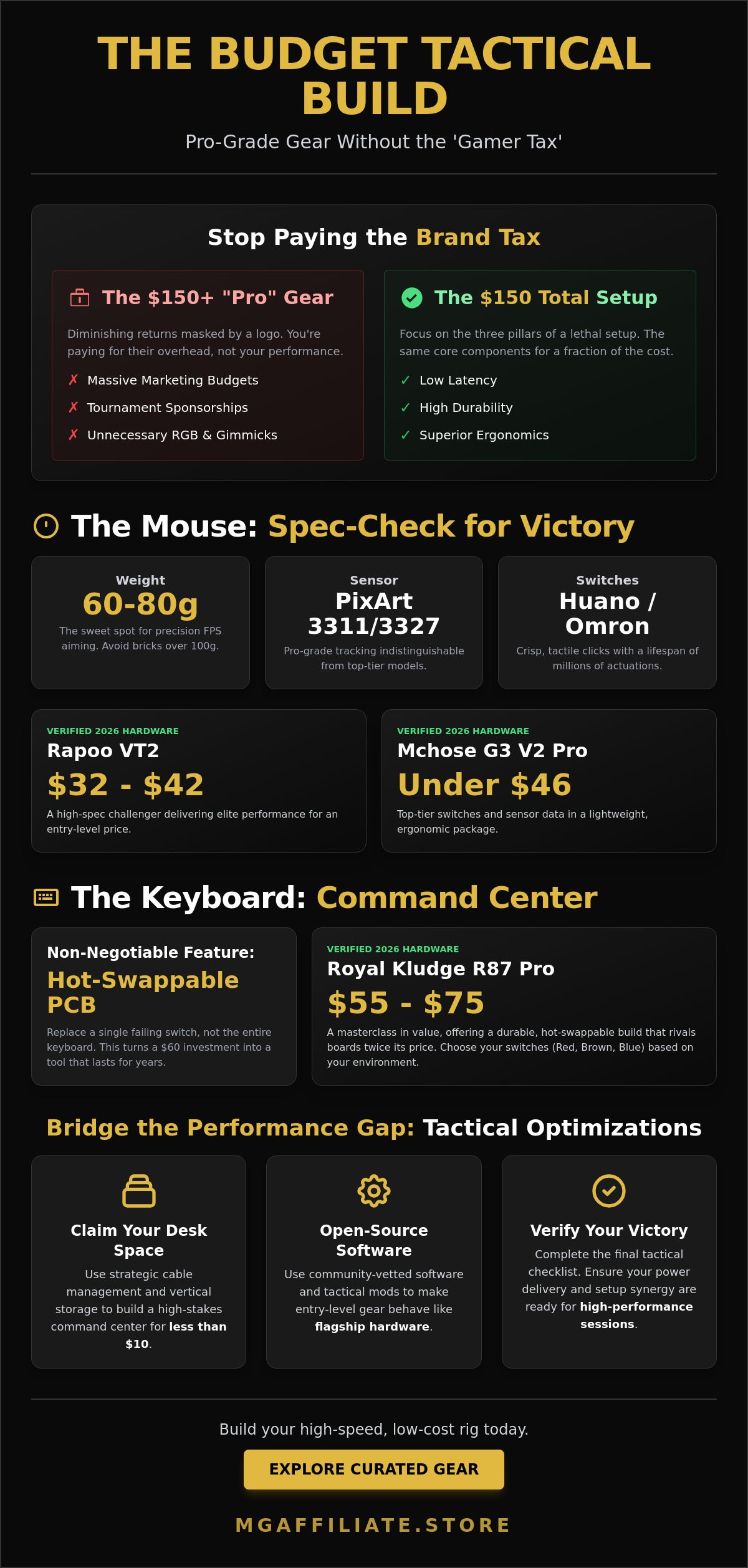
You’ve been lied to. The flashy box and the pro-player endorsement on that $150 mouse don't make it track better. It’s a tax. Specifically, it is a "Gamer Tax" designed to fund massive marketing budgets and tournament sponsorships. In 2026, the barrier to entry for elite performance has collapsed. Building a high-tier setup no longer requires a thousand-dollar investment; it requires a tactical mindset. You must learn to choose specs over logos and engineering over aesthetics. This is the era of the "Budget Tactical" build, where we hunt for the best budget gaming accessories based on raw data rather than brand prestige.
Manufacturing efficiency has reached a tipping point. The same high-precision sensors and mechanical switches that were exclusive to flagship models two years ago are now standard in entry-level gear. To win, you must focus on the three pillars of a lethal setup: Latency, Durability, and Ergonomics. If a video game accessory doesn't excel in these three categories, it is dead weight, regardless of how many RGB zones it has. You are building a tool for domination, not a desk ornament.
The Myth of the $150 Mouse
Diminishing returns hit gaming mice harder than any other category. Modern budget sensors like the PixArt 3311 or 3327 provide tracking so precise that the human hand cannot distinguish them from top-tier alternatives. You don't need a 30,000 DPI sensor when professional eSports players rarely exceed 800 or 1,600 DPI. Latency is the millisecond delay between your physical input and the on-screen reaction, a metric where modern budget wireless chips now rival wired connections. Stop overpaying for "pro" labels when the silicon inside is identical to the budget wins we’ve identified.
Curated vs. Commercial: Why You Need a Strategy
The biggest trap you’ll face is the endless scroll. Unverified Amazon listings are a graveyard of "e-waste" that will break within a month. You need a filter. This is why smart players rely on curated shopping collections to find gear that has been vetted for actual combat. A full accessory refresh in 2026—including a high-spec mouse, mechanical keyboard, and wireless headset—should cost you between $150 and $200 total. If you’re spending more, you aren't buying performance; you’re buying a CEO’s third vacation home. Stick to the checklist and keep your capital for what matters: the games themselves.
The Core Gear Checklist: Mice, Keyboards, and Headsets
Buying gear based on a logo is a rookie mistake. You need to look at the internal components. In 2026, the best budget gaming accessories are defined by their ability to mimic flagship performance without the flagship price tag. This isn't about finding the cheapest piece of plastic on the market. It’s about tactical selection. If you don’t know what switches are in your mouse or the polling rate of your keyboard, you aren't playing to win. You're just playing.
The global gaming accessories market is projected to grow to $12.6 billion in 2026. This massive scale means manufacturers are fighting for your attention with high-spec hardware at aggressive prices. You can now secure a setup that dominates the leaderboard for less than the cost of a single "premium" brand-name keyboard. To do this, you must prioritize raw utility over marketing gimmicks like "7.1 Virtual Surround" or "Infinite RGB."
The Budget Mouse Spec-Check
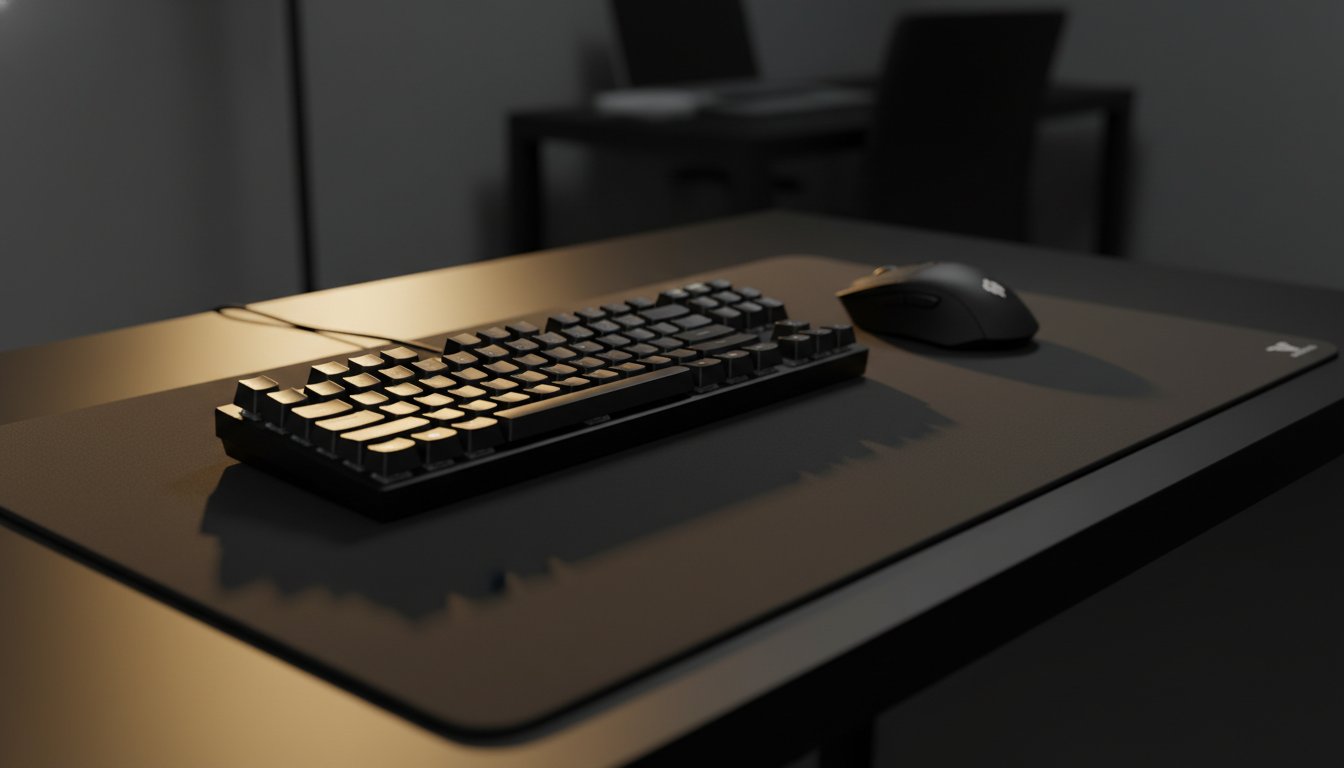
Weight and sensor accuracy are the only metrics that matter. Forget the lighting zones. A mouse that weighs over 100g is a brick that slows your reaction time. You want to hit the sweet spot between 60g and 80g for precision FPS play. Look for models like the Rapoo VT2, which verified 2026 data shows retails between $32 and $41.99, or the Mchose G3 V2 Pro for under $46. These aren't just "cheap" mice. They use high-end Huano or Omron switches that offer a crisp, tactile click and a lifespan of millions of actuations. If you want a reliable starter, the Logitech G203 remains a staple, but the current market belongs to these high-spec challengers.
Mechanical Keyboards for Less
Membrane keyboards are for offices, not arenas. In 2026, a mechanical board is non-negotiable. Your primary goal is finding a hot-swappable PCB. This feature allows you to replace a single failing switch instead of binning the entire unit, ensuring your $40 to $70 investment lasts for years. The Royal Kludge R87 Pro, verified at approximately $55 to $75, is a masterclass in value. You need to choose your switches based on your environment. Red switches are linear and quiet for late-night sessions. Blue switches are clicky and loud. Brown switches offer a middle-ground tactile bump. Choosing products that make life easier means selecting gear that fits your workflow without sacrificing speed.
Don't ignore the audio. The Scapendy Wireless Gaming Headset, priced between $34 and $36.99 as of mid-2025, provides the spatial awareness you need to hear footsteps without the bloated price of "Pro" branding. Finally, never ignore your mousepad. A $10 large-format cloth pad provides a consistent friction surface that your desk simply cannot match. It is the most underrated performance booster in your arsenal. If you're ready to stop guessing, check out our curated collections to see the exact gear we’ve vetted for performance.
The Setup Synergy: Utility and Aesthetic Accessories
A cluttered desk is a tactical failure. You cannot execute high-precision movements if your mouse is fighting a tangled web of charging cables. Many gamers spend hundreds on internal components only to let their performance bleed out through a messy, unoptimized environment. True "Setup Synergy" happens when your utility gear works as hard as your hardware. In the search for the best budget gaming accessories, most people ignore the $5 wins that actually transform the experience. You don't need a custom-built mahogany desk. You need a system that eliminates distractions and maximizes your physical range of motion.
A $5 pack of Velcro ties is the single most cost-effective performance upgrade you will ever buy. By securing your peripheral cables to your desk legs or monitor arms, you eliminate cable drag and "snagging" during intense flick shots. This isn't just about looking clean for a photo. It’s about removing the physical resistance that ruins your consistency. Combine this with under-desk hooks for your headset to free up vertical space and keep your primary surface clear for your mousepad.
Desk Organization as a Performance Metric
Your "battle station" has a psychological impact on your focus. A clean, organized space reduces the cognitive load on your brain, allowing you to stay "in the zone" for longer sessions. Under-desk cable trays are the hidden secret of elite aesthetic setups. They hide the power bricks and messy looms that usually sit at your feet. Use a simple monitor riser to bring your screen to eye level. This improves your posture and frees up the space directly under your monitor for your keyboard when you need extra room for wide mouse movements. It’s a low-cost adjustment that pays dividends in comfort and speed.
Hall Effect: The End of Stick Drift
If you use a controller, you’ve likely felt the frustration of stick drift ruining a competitive match. Traditional controllers use potentiometers that wear down through friction. Hall Effect sensors use magnets to track movement, meaning there are no physical parts to rub together and fail. This tech is the new budget king for longevity. While standard console controllers often fail within a year, Hall Effect pads like the Gulikit KK3 Max, verified at $80, represent the "sweet spot" for long-term value. Even entry-level options like the GameSir Nova Lite are bringing this tech to the masses. Durability is the ultimate budget hack; buying one reliable controller is always cheaper than buying three disposable ones. To see how these components fit into a complete build, explore our curated shopping collections for vetted, high-durability gear.
Finally, consider budget RGB as a tool, not just a decoration. Bias lighting—LED strips placed behind your monitor—reduces eye strain by providing a soft glow that balances the screen's brightness. It makes your setup look professional while protecting your vision during late-night grinds. When you stop buying gear for the "look" and start buying for the synergy, your performance will follow.
Tactical Optimization: Making Cheap Gear Feel Expensive
The gear you just bought is only 50 percent of the equation. Buying the best budget gaming accessories is a strategic win, but leaving them at factory settings is a tactical error. You are leaving performance on the table. High-tier players don't just plug and play; they calibrate. If your keyboard feels "scratchy" or your headset sounds "tinny," it isn't necessarily because the hardware is bad. It’s because you haven't optimized it. Optimization is the great equalizer that bridges the gap between a $40 peripheral and a $200 flagship.
Stop blaming the price tag for your missed shots. If you aren't willing to spend twenty minutes fine-tuning your setup, you aren't serious about winning. You have the hardware. Now, you need the methodology to make it scream.
Open Source Power-Ups
Software is where budget gear truly transforms. Use RawAccel to implement custom mouse acceleration curves that compensate for any minor sensor inconsistencies. It provides a level of control that most native brand software cannot match. For your audio, download Equalizer APO. With the right configuration, you can tune a $30 headset to mimic the soundstage of a $100 studio pair by boosting specific frequency ranges for footsteps. To verify your hardware is performing as promised, use a web-based polling rate checker to ensure your budget wireless mouse is hitting its advertised 1,000Hz or 4,000Hz target without drops. If it isn't, move your receiver closer or check for USB interference. Fix the signal, win the game.
The DIY "Pro" Feel
Physical mods turn "cheap" plastic into a premium tool. If your mechanical keyboard sounds hollow or clacky, buy a $10 lube kit. Applying a small amount of Krytox to your switches and stabilizers eliminates rattle and creates a buttery, high-end typing experience. It’s a tedious process, but the results are undeniable. For your mouse, add a pack of universal grip tape. This solves the "slippery" feel of budget plastic and gives you absolute control during high-intensity flick shots. Some enthusiasts even use the "Coin Mod" or internal weight removal to customize the center of gravity. These aren't just hobbies; they are performance upgrades that cost almost nothing.
Maintenance is your final pillar. Budget gear often lacks the heavy-duty coatings of premium models, meaning skin oils and dust build up faster. Clean your mouse sensor with a Q-tip and isopropyl alcohol every month. Wash your cloth mousepad to maintain consistent friction. A neglected setup is a failing setup. If you want to see the exact tools and components we use to build these high-performance rigs, browse our curated hardware collections now. Don't just own the gear. Master it.
Your Final Build Checklist: The Ultimate Low-Cost Rig
You have the blueprint. Now you must execute. Building a high-performance environment with the best budget gaming accessories isn't a matter of luck; it’s a matter of following the system. Most players fail because they get paralyzed by choice or distracted by flashy, useless features. You aren't most players. You understand that every component in your setup must serve a specific, tactical purpose. If a piece of gear doesn't directly improve your reaction time, your comfort, or your consistency, it doesn't belong on your desk.
Before you finalize your build, run through this tactical checklist to ensure no performance has been left on the table:
- The Mouse: Sub-80g weight with a verified high-precision sensor and low-latency wireless.
- The Keyboard: Hot-swappable mechanical switches to ensure five-year durability.
- The Audio: Spatial awareness focus with a clear, noise-canceling microphone.
- The Controller: Hall Effect sensors to permanently eliminate stick drift.
- The Utility: Cable management ties and bias lighting to optimize the environment.
The 5-Minute Compatibility Audit
Your hardware is only as good as the ports it’s plugged into. In 2026, high-polling rate devices are the standard, but they are demanding. Ensure your mouse and keyboard are connected to USB 3.0 or higher ports. Plugging a 4,000Hz polling mouse into an old USB 2.0 slot will choke your bandwidth and introduce the very input lag we are trying to kill. Next, measure your desk. An XXL mousepad is a game-changer, but only if your desk depth allows it to sit flat without overhang. Finally, verify your driver support. While most 2026 budget wins are plug-and-play, ensure your firmware is updated for Windows 11 or Windows 12 to maintain peak stability during competitive play.
Execution: Stop Scrolling, Start Building
The biggest tactical error you can make is waiting for the "perfect" sale. In the fast-moving 2026 market, high-value components sell out or get replaced by inferior revisions quickly. If you've found the specs you need at the right price, pull the trigger. Stop wasting hours scrolling through unverified listings that lead to e-waste. We’ve done the heavy lifting for you. MG Affiliate Store filters the noise to bring you the signal, presenting only the gear that meets our rigorous performance standards. Check out our current curated gaming finds here to finalize your build today.
Your setup is a weapon. It is a tool designed to increase your win rate and sharpen your skills, not a trophy to be admired from a distance. Don't get caught up in the aesthetics of "pro" branding. Focus on the raw data, the tactile feedback, and the results on the screen. Build it. Optimize it. Then go dominate.
Claim Your Competitive Edge
You now have the tactical blueprint to stop bleeding cash on marketing hype. The era of overpaying for a logo is over. By focusing on raw sensor data, mechanical durability, and strategic optimization, you've learned that elite performance is a choice, not a purchase. You've seen how the best budget gaming accessories of 2026 rival flagship gear when calibrated with precision. It's time to stop scrolling through unverified listings and start building your command center.
Our collections are curated by performance experts who demand high ROI and long-term durability. Every link has undergone real-world testing to ensure it meets the standards of a professional setup. We've filtered out the e-waste so you can focus on the win. Upgrade your setup with our hand-picked budget gaming wins today. Your previous lack of progress was merely a tactical error. Now that you have the right tools and the right methodology, the leaderboard is yours for the taking. Go dominate.
Frequently Asked Questions
What is the best budget gaming brand in 2026?
Rapoo and Royal Kludge are currently dominating the market for the best budget gaming accessories. Rapoo delivers high-polling rate mice like the VT2 for under $42, while Royal Kludge provides hot-swappable mechanical boards like the R87 Pro for under $75. These brands prioritize internal specs over marketing bloat, making them the tactical choice for savvy builds that require pro-grade performance.
Can a budget gaming mouse actually compete with a Razer or Logitech Pro?
Yes, because the internal silicon is often identical. High-end budget mice now use PixArt sensors and 4K wireless chips that match the tracking accuracy and latency of flagship models. You're losing the brand logo and proprietary software features, but the raw performance on the glass is virtually indistinguishable in competitive play. Stop paying the brand tax and focus on the sensor model.
What should I look for in a gaming keyboard under $50?
Prioritize hot-swappable sockets and a detachable USB-C cable above all else. Hot-swapping allows you to replace individual switches if they fail, which is the only way to ensure a cheap board lasts for years. Avoid membrane "gaming" boards entirely. Even at this price point, you should expect true mechanical switches and decent stabilizers to prevent distracting key rattle during intense sessions.
Is it worth buying a used high-end headset or a new budget one?
Buy a new budget headset to avoid hygiene issues and battery degradation. Used headsets often have worn-out ear pads and failing internal batteries that are nearly impossible to replace. A new budget wireless headset like the Scapendy offers fresh components and modern low-latency tech for under $40. This provides a significantly better long-term ROI than someone else's discarded, aging gear.
How do I know if a budget accessory is a scam or a deal?
Check for specific sensor and switch models in the product description. A real deal will list technical components like "PixArt 3395" or "Huano switches." A scam relies on vague buzzwords like "Ultra-Fast" or "Pro-Gamer Grade" without providing verifiable data. Stick to curated collections that have already undergone real-world testing to avoid wasting your capital on useless e-waste.
What are Hall Effect sensors and why do they matter for budget gamers?
These sensors use magnets instead of physical friction to track movement. This technology is critical because it permanently eliminates stick drift in controllers and provides ultra-precise actuation in keyboards. For a budget gamer, this means your gear won't develop dead zones or ghosting over time. It makes Hall Effect tech a superior long-term investment compared to traditional potentiometer-based pads.
Do budget gaming accessories have high input lag?
Not if you choose 2.4GHz wireless or wired connections. Modern best budget gaming accessories have solved the latency issues that plagued cheap gear in previous years. Just ensure your accessory uses a dedicated USB dongle rather than relying solely on Bluetooth. Bluetooth is for office productivity; 2.4GHz is for the arena. Most 2026 budget wins now feature sub-1ms response times.
How can I make my budget gaming setup look more aesthetic?
Focus on cable management and lighting consistency rather than expensive furniture. A $5 pack of Velcro ties to hide wires and a single $10 LED strip for bias lighting behind your monitor will transform your space instantly. Keep your color palette limited to two or three tones. A clean, organized workspace looks professional and high-end regardless of the total hardware cost.