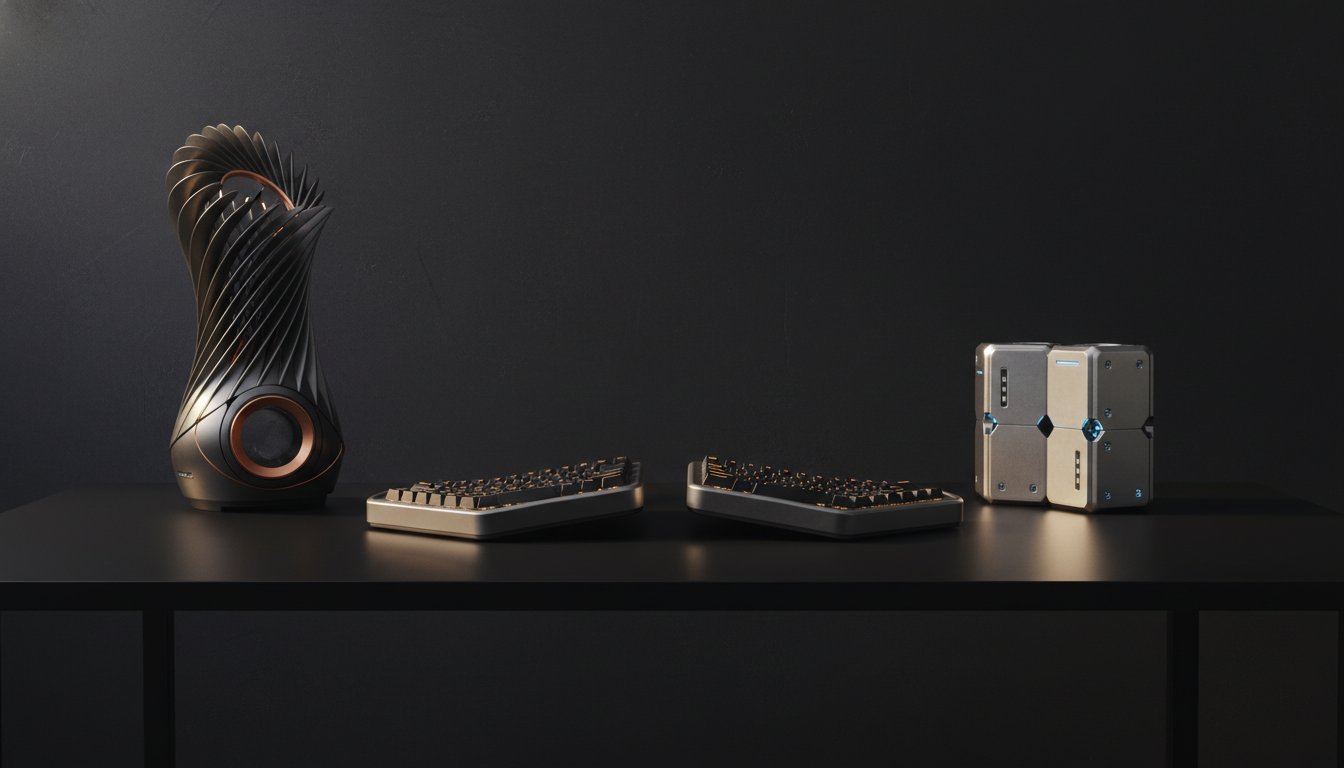
The most effective tool in your arsenal shouldn't look normal; it should look like a solution. Most people settle for generic products that fail to solve their specific, grinding daily frictions because they're afraid of looking ridiculous. You don't have that luxury. High-performance living requires specialized gear, even if that means investing in weird but useful gadgets that the average consumer dismisses as a gimmick. If a tool eliminates a recurring bottleneck in your life, its aesthetics are irrelevant.
You're likely exhausted by generic shopping lists that offer nothing but information overload and recycled junk. You want results. Not clutter. This tactical guide identifies exactly why unconventional designs are the secret to superior function in 2026. We'll show you how to build a high-leverage toolkit using curated 2026 releases, like the $99.99 Fitbit Air and the modular HMD Fusion. Stop wasting money on mediocrity and start leveraging niche utility to reclaim your time.
Key Takeaways
- Identify the "Generalist Trap" that forces you to settle for mediocre results and learn how niche utility design eliminates specific life frictions.
- Master the skeptic’s filter to distinguish between viral social media hype and the ergonomic superiority found in high-performance weird but useful gadgets.
- Apply the "Three-Use Rule" to your current inventory to ruthlessly purge plastic junk and make room for tools that earn their place in your toolkit.
- Discover the tactical areas in your home office and kitchen where specialized gear provides the highest leverage for your daily efficiency.
- Stop collecting clutter and start curating a high-value toolkit designed to automate your environment and reclaim lost productivity.
The Science of Friction: Why Weird Gadgets Outperform Standard Tools
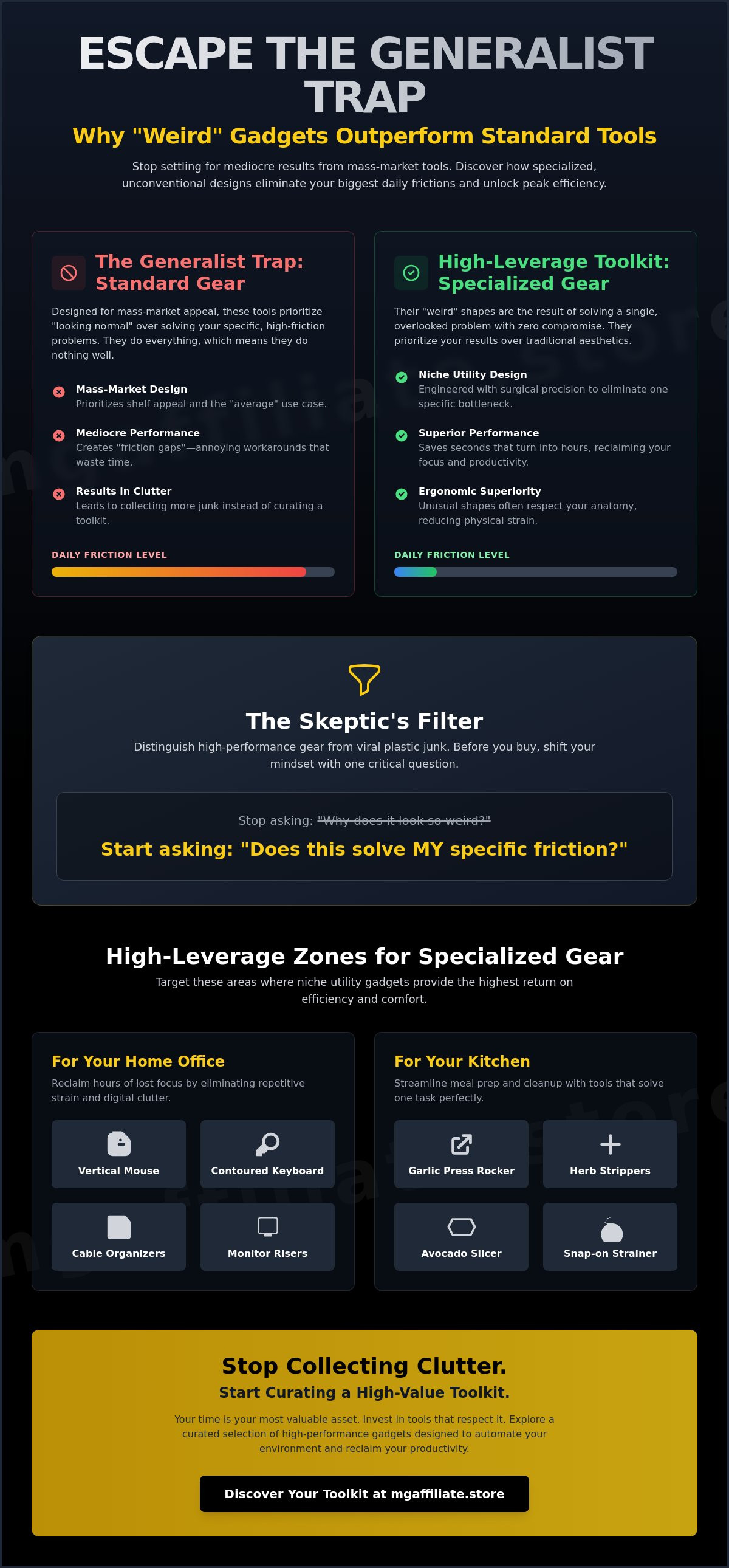
Most consumers fall into the Generalist Trap. You buy a tool because it claims to do everything. It ends up doing nothing well. Mass-market engineering prioritizes the "average" use case. This means it ignores your specific, high-friction problems. High-performance living requires a different approach. You need tools designed for the 1 percent of tasks that actually slow you down. If you want superior results, you must stop shopping like an amateur.
This is where weird but useful gadgets enter the picture. Their strange shapes aren't for show. They are the logical result of solving a single, overlooked problem with zero compromise. If a tool looks "normal," it's probably because it was designed to sit on a retail shelf, not to solve a bottleneck in your workflow. Aesthetics are often the enemy of efficiency. When you prioritize how a tool looks over how it performs, you've already lost.
Defining Niche Utility in 2026
In 2026, specialized engineering has moved beyond the one-size-fits-all model. Rapid 3D prototyping now allows designers to bring unconventional, hyper-focused tools to market without needing mass-market approval. A gadget's "weirdness" is now a marker of its specificity. It shows the designer prioritized your results over traditional aesthetics. Unlike the concept of Chindōgu, where inventions are clever but ultimately impractical, modern niche utility focuses on removing real-world friction with surgical precision.
The Efficiency Gap: Standard vs. Specialized
Standard office or kitchen gear leaves "friction gaps." These are the tiny, annoying moments where a tool almost works but requires an inefficient workaround. You might spend twenty seconds struggling with a standard cable management system or a generic kitchen utensil. Over a year, those seconds turn into hours of lost focus and unnecessary irritation. Niche utility is the bridge between standard gear and specific human needs.
You must adopt the mindset of a tactical shopper. Stop asking "Why does it look like that?" and start asking "Does this solve my specific friction?" The psychological shift from "that looks funny" to "that solves my problem" is the first step toward building a high-leverage toolkit. You don't need more tools. You need better ones. You need weird but useful gadgets that respect your time more than they respect traditional design rules. Efficiency isn't always pretty, but it is always profitable.
From Viral Trends to Real Utility: Decoding the 'Weirdness' Factor
Social media is a landfill of plastic garbage. You see a ten-second clip of a "revolutionary" tool and your instinct screams "gimmick." You're usually right. Most viral products are designed to be sold, not used. They solve marketing problems, not human ones. However, the 22 percent of shoppers who used AI search tools for product research in 2025 have learned to spot the signal in the noise. The transition from a TikTok trend to a permanent fixture in your toolkit happens the moment a product moves from being "interesting" to being "indispensable."
True performance gear doesn't care about your aesthetic sensibilities. It cares about output. To find weird but useful gadgets that actually deliver, you must look past the viral filters. A gimmick relies on novelty to mask poor construction. A professional-grade gadget uses unconventional design to achieve a specific result that standard tools can't touch. If you want to stop wasting money, learn to identify the "utility arc." This is the point where a strange design choice translates directly into saved time or reduced physical strain.
The Ergonomics of the Unusual
Traditional tool design is often a relic of the past. It assumes your body hasn't changed, even if your workload has. Non-traditional grips and aggressive angles are frequently required to reduce physical strain during repetitive tasks. Think about the geometry of a vertical mouse or a contoured keyboard. They look alien because they respect your anatomy. When you see weird geometry in a tool, you're looking at a designer who prioritized your joints over a "clean" look. Ergonomic weirdness is a feature, not a bug, of high-performance gear. It provides the leverage and force needed to eliminate friction without taxing your body.
Material Innovation in Niche Tools
In 2026, the "strange" look of a product is often dictated by its materials. We're seeing medical-grade silicone and aerospace alloys migrate into everyday household items. These materials allow for shapes that were impossible five years ago. For example, the HMD Fusion smartphone uses "Smart Outfits" to change its very structure for different tasks. The Quark AI Glasses S1, priced at approximately $537, use specialized frames to house advanced sensors without the bulk of traditional tech. When materials dictate shape, you get durability that outlasts any novelty. You're not just buying a shape; you're buying a system. You can explore these high-leverage systems in our curated shopping collections to ensure your gear matches your ambitions.
Build quality is your final filter. Does the "weird" design feel solid, or is it just thin plastic? High-utility tools use their unconventional shapes to reinforce stress points. They don't just look different; they feel different. If a gadget doesn't offer a tactile sense of purpose, it's just clutter. If it does, it's the leverage you've been looking for.
High-Performance Hacks: Weird Utility Gadgets for Daily Efficiency
Efficiency isn't found in grand gestures. It's found in the margins. You lose hours every month to micro-tasks that drain your mental energy. These tiny frictions, like searching for a specific tool, struggling with poor lighting, or inefficient food prep, accumulate into massive productivity leaks. You need to plug those leaks. Frictionless living is the goal. Many products that make life easier started as "weird" prototypes that standard consumers didn't understand. You aren't a standard consumer. You are a tactician looking for leverage.
Identifying high-friction areas is your first mission. Look at your home office. Look at your kitchen. These are the engines of your daily life. If they are clunky, your output is clunky. Investing in weird but useful gadgets isn't about novelty; it's about reclaiming your cognitive bandwidth. When you automate a repetitive physical task, you free your brain for high-value decision-making. Don't let a poorly designed spatula or a generic mouse be the reason you feel drained by 2 PM.
The Tactical Kitchen: Beyond the Chef's Knife
Prep work is a notorious bottleneck. Amateurs think one good knife is enough. Professionals know that specialized tools provide a higher ROI. Saving 30 seconds on a task you perform 365 times a year reclaims three hours of your life. That's time you can spend on growth, not garlic. Some viral amazon kitchen tools have moved beyond the hype to become essential tactical gear. We're seeing a massive comeback for single-use gadgets in high-tier kitchens. A tool that does one thing perfectly is always superior to a tool that does ten things poorly. Efficiency demands specialization.
Workspace Optimization: Weird Tech That Works
Your workspace is a battlefield. Carpal tunnel and eye strain are the enemies. Standard peripherals are often designed for the lowest common denominator, not for the person sitting at their desk for ten hours a day. You need unconventional shapes to prevent physical degradation. You can integrate best budget tech finds 2024 into a modern 2026 setup to create a high-utility environment without overspending. Focus on ambient gadgets that manage air quality and light levels automatically. If you have to manually adjust your environment, you've already lost the focus game. Build a system that works for you so you can focus on the work that matters. Weird but useful gadgets are the secret weapon for anyone serious about peak performance.
The Skeptic’s Filter: How to Identify Useful Innovation vs. Plastic Junk
Your home is not a museum for failed ideas. Most people treat shopping like a hobby; they accumulate clutter because they lack a vetting framework. If you want to master the art of high-performance living, you must become a ruthless gatekeeper. You need a filter that separates genuine weird but useful gadgets from the sea of plastic junk that floods the market every year. High-leverage tools earn their place through repeated, measurable utility. Everything else is just a distraction that drains your bank account and your mental space.
The "Three-Use Rule" is your primary defense. Before you commit to a permanent spot in your toolkit, a gadget must solve a recurring problem three times in its first week. If it sits in a drawer, it’s a failure. You should also look for red flags in the design. When "weird" is used to cover for flimsy materials or poor construction, it’s a gimmick. Organic success leaves a trail of specific, detailed reviews that mention the exact friction the tool removed. Manufactured hype relies on vague adjectives and high-pressure marketing. Don't be the person who falls for a polished video only to receive a piece of unrepairable garbage.
The Anatomy of a Gimmick
Multi-tools are the most common offenders. They claim to do ten things, but they usually fail at all ten because they compromise on every individual function. This is an over-engineered solution to a non-existent problem. You don't need a spatula that is also a flashlight. The "As Seen on TV" trap relies on creating a sense of artificial urgency. If a product requires a high-pressure sales pitch to sound useful, it probably isn't. Real utility is self-evident. It solves a pain point so effectively that the marketing becomes secondary to the performance.
Vetting the Source: Where to Buy Niche Gear
Finding the coolest products on amazon requires a different mindset than buying a pack of batteries. You have to look for patent filings and original designer credits to ensure you aren't buying a low-quality clone. Clones ignore the subtle ergonomic details that make weird but useful gadgets effective in the first place. Prioritize third-party testing videos over brand-produced lifestyle shots. These creators often stress-test the gear in real-world conditions, showing you the repairability and sustainability of the build. You can skip the guesswork and start building a high-leverage toolkit by accessing our curated shopping collections, where every item has already passed the skeptic’s filter.
Durability is the ultimate mark of a professional tool. In 2026, the best niche gadgets are designed to be maintained, not replaced. If a strange-looking tool is built from aerospace alloys or medical-grade silicone, its shape is likely a functional necessity. If it’s thin plastic with no way to replace the battery or parts, leave it on the shelf. You aren't just buying a gadget; you're investing in a solution. Make sure that solution is built to last.
Curating Your Toolkit: Why Specialized Gear is the Ultimate Leverage
High-performance isn't a vague state of mind. It's a structural reality. You are the sum of the tools you use. If those tools are generic, your output will be average. Curating a toolkit of weird but useful gadgets isn't about eccentricity; it's about surgical precision. You must stop "collecting" toys and start "curating" assets. A collection is just a pile of things. A curated toolkit is a synchronized system where every item serves a specific, high-leverage purpose. If it doesn't move the needle on your daily efficiency, it doesn't belong in your space.
The psychological benefit of a frictionless environment is massive. Every time you struggle with a clunky tool or a generic workaround, you leak cognitive energy. You drain your willpower on micro-tasks that should be automated or simplified. When your environment is optimized, you reclaim that energy for the high-stakes decisions that actually build your future. This is why the "High-Value/High-Utility" lifestyle is the only logical choice for anyone serious about peak performance. Efficiency is the ultimate leverage.
The End of Endless Scrolling
Decision fatigue is the hidden tax of the modern marketplace. You spend hours reading conflicting reviews and comparing specs for products that might not even work. That is time you aren't producing. Passive consumers scroll; tactical owners execute. The fastest way to a high-performance setup is to follow a trusted curator who has already applied the skeptic’s filter to the market. You can skip the noise and move straight to the solution by exploring professional curated shopping collections. Your time is too valuable to waste on trial and error.
Building Your 2026 Utility Roadmap
Don't try to overhaul your life in a single afternoon. Start small. Identify your top three daily frustrations. Is it the way you prep meals? The way your workspace lighting affects your focus? Once you name the bottleneck, kill it with specialized gear. Adopt a "buy it once" philosophy. If a tool is truly among the top weird but useful gadgets, it will be built from the high-grade materials we've identified, like aerospace alloys or medical-grade silicone. It will outlast ten generic versions. If you're ready to stop settling for mediocrity and start leveraging niche utility, Visit MG Affiliate Store for the latest vetted utility gear. Your optimized future starts with the right tools.
Master Your Environment with Tactical Precision
You've moved past the amateur stage of passive consumption. You now understand that a tool's unconventional shape is often the signature of its specialized engineering. By applying the Skeptic's Filter and the Three-Use Rule, you've learned how to bypass manufactured hype and invest in tools that provide a legitimate ROI on your time. Niche utility isn't a luxury; it's the foundation of a frictionless existence. Building a toolkit of weird but useful gadgets is the fastest way to reclaim your cognitive bandwidth and focus on high-value output.
Don't let decision fatigue stall your progress. Stop scrolling through endless lists of plastic junk and start following a proven methodology for environmental optimization. Our performance strategists have already done the heavy lifting, vetting every product for real-world utility and long-term durability. It's time to stop settling for mediocre gear that fails when you need it most. Upgrade your life with our vetted collections at MG Affiliate Store and start leveraging the power of specialized design. You have the framework. Now, take the action.
Frequently Asked Questions
What makes a gadget 'weird' but actually useful?
A gadget is weird but useful when its design is dictated entirely by a single, hyper-focused problem rather than mass-market appeal. If a tool looks strange, it's usually because the designer prioritized your ergonomic health or your time over traditional aesthetics. These weird but useful gadgets exist to solve the specific tasks that standard, general-purpose tools fail to address properly.
How do I know if a viral gadget is a scam or a real tool?
You distinguish real utility from a scam by applying the Skeptic’s Filter and looking for organic review patterns. Scams rely on high-pressure marketing and vague adjectives to hide poor construction. Real tools prove their worth through detailed feedback from users who mention specific friction points that were removed. If a product requires a viral video to seem functional, it’s likely plastic junk.
Are weird gadgets more expensive than standard ones?
Specialized gear is priced based on its material quality and engineering precision rather than its shape. While some niche items use high-end components, they often eliminate the unnecessary features that bloat the price of mass-market tools. You aren't paying for novelty; you're paying for a specific, durable result. If a tool lasts five times longer than a standard one, it's the more economical choice.
Do these unconventional tools have a learning curve?
Yes, unconventional tools often require a short period of adaptation because they challenge your existing muscle memory. Ergonomic gear might feel alien for the first few uses, but this is a tactical investment. The initial learning curve is a small price to pay for long-term efficiency and the elimination of physical strain during repetitive tasks.
Can niche gadgets really improve my daily productivity?
Niche gadgets improve productivity by eliminating the micro-frictions that drain your daily mental energy. When you solve a small, recurring bottleneck, you prevent the cognitive fatigue that usually sets in by mid-afternoon. Protecting your bandwidth for high-stakes work is the ultimate goal. These tools don't just save time; they preserve the focus you need to execute your long-term strategy.
What are the best categories to look for weird but useful gadgets?
The most effective categories for weird but useful gadgets include workspace peripherals, tactical kitchen gear, and health-monitoring wearables. These areas are rife with repetitive tasks and ergonomic failures that standard tools ignore. Look for gadgets that manage your invisible environment, such as automated air quality sensors or light management systems, to keep your focus sharp without manual intervention.
Where can I find vetted lists of these products without the hype?
You can find vetted lists of high-utility gear by following performance strategists who prioritize results over viral trends. Instead of scrolling through social media, look for curated shopping collections that apply a rigorous vetting framework to every item. These resources focus on high-leverage products that solve documented life frictions rather than chasing the latest aesthetic fad.
How do I avoid cluttering my home with useless gadgets?
Avoid clutter by ruthlessly applying the Three-Use Rule to every new purchase. If a gadget doesn't solve a recurring bottleneck at least three times in its first week, it doesn't earn a permanent spot in your toolkit. Shift from being a passive collector to a tactical owner who only invests in gear that offers a measurable improvement to your daily workflow.