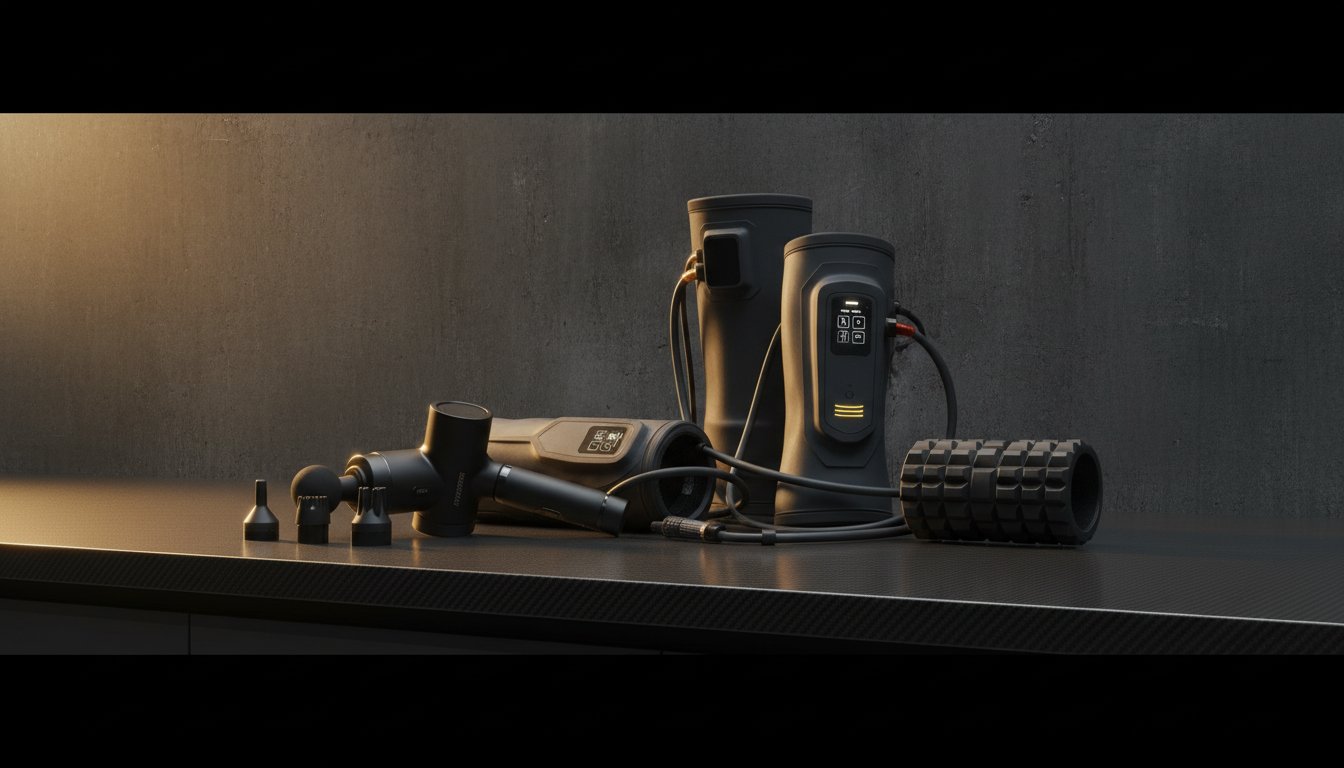
If you're still treating recovery as a passive "off day," you're effectively throwing away 30% of your training volume. The right recovery tools for athletes aren't luxury items. They're the essential hardware required to turn today's sweat into tomorrow's power. You know the feeling of hitting a performance plateau while your muscles remain chronically heavy and sore. You've seen the viral ads for overpriced gadgets and felt the frustration of conflicting advice. It's time to stop guessing and start executing a professional-grade strategy.
You deserve a recovery protocol that works as hard as your training sessions do. This comparison guide bridges the gap between mediocre rest and elite performance by highlighting the systems that deliver a real physiological ROI. We've curated the top-performing collections to help you stop leaving gains on the table and start seeing a faster turnaround between sessions. From percussive therapy to advanced compression, we're breaking down the 2026 high-performance landscape to ensure you never overpay for hype again. Read on to discover the exact tools that will reduce your injury risk and simplify your path to the podium.
Key Takeaways
- Bridge the "Recovery Gap" by moving beyond passive rest and adopting active systems that match your training intensity.
- Compare the heavy hitters in recovery tools for athletes to determine if you need targeted deep tissue repair or a full systemic flush.
- Master the physiological war of thermal regulation to crush inflammation and spike your performance metrics.
- Stop neglecting the marginal gains found in professional-grade footwear and smart rollers that work while you're on the move.
- Access curated shopping collections designed to build your custom recovery lab, regardless of whether your budget is $200 or $1,000.
The Recovery Gap: Why Your Training is Failing Without Pro-Grade Systems
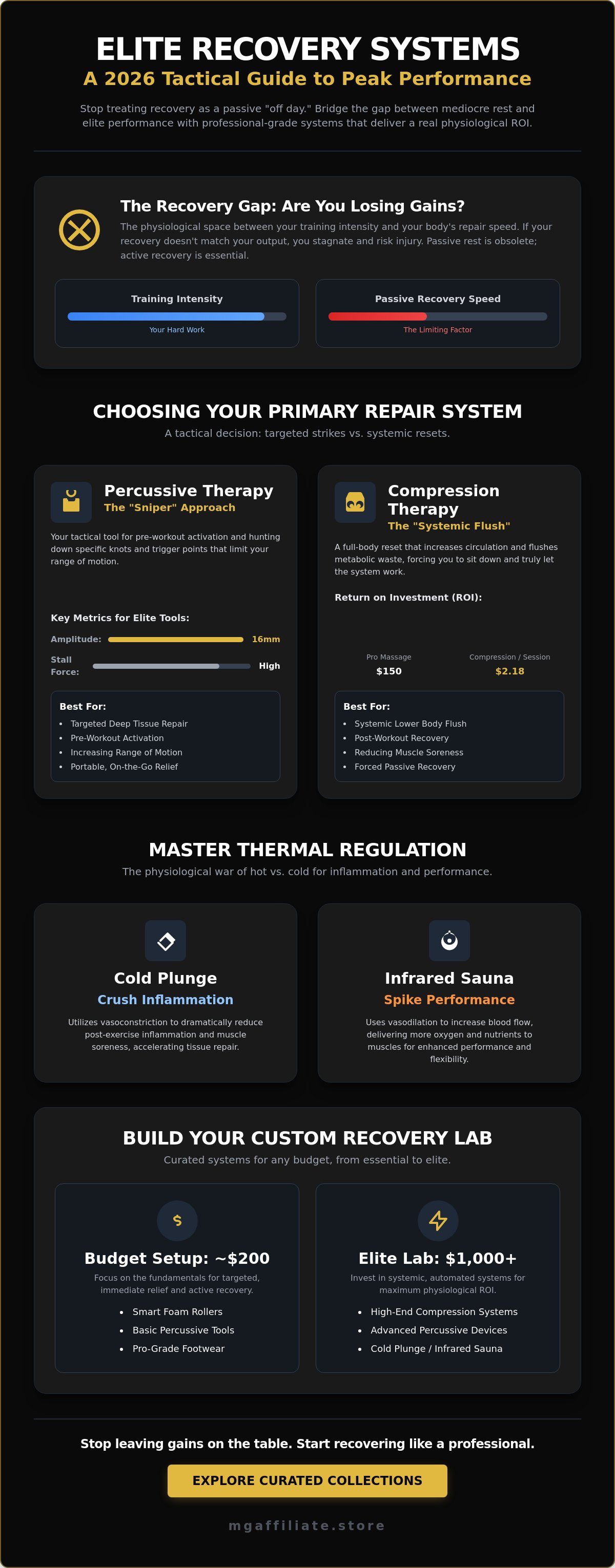
You're training like a pro but recovering like an amateur. That's the harsh reality for most athletes in 2026. The Recovery Gap is the physiological space between your training intensity and your body's natural repair speed. When you push your limits, you create micro-trauma. If your repair speed doesn't match that destruction, you stagnate. You stop growing. You start breaking.
Traditional rest is dead. The "couch method" of just sitting around and waiting to feel better is insufficient for modern performance standards. It's passive. It's slow. In a world where the sports recovery technology market is valued at $1.7 billion, relying on gravity and hope is a tactical error. If you aren't recovering as hard as you train, you are losing money and time. Professional recovery tools for athletes bridge this gap by forcing the body into an accelerated state of repair. It isn't just about physical tissue; it's about the psychological edge. Using elite systems shifts your mindset. It transforms you from a hobbyist into a strategist who views every hour as a performance opportunity.
The Science of Accelerated Repair
Waiting to feel better is a gamble you can't afford to take. To stay competitive, you must understand blood flow dynamics. Pro-grade systems use myofascial release to break up adhesions and stimulate circulation. This isn't just about comfort. It's about mechanics. Increased blood flow delivers the nutrients required for cellular reconstruction while lymphatic drainage flushes metabolic waste. Failing to manage this process leads to chronic inflammation and increases the risk of Sports injuries that can sideline your career for months. You don't have time for a "wait and see" approach. You need a protocol that dictates terms to your physiology.
Hype vs. Hardware: Cutting Through the Noise
The market is flooded with viral gimmicks. In 2026, you must distinguish between a "gadget" and a legitimate recovery system. A gadget is a standalone toy that lacks data integration or physiological depth. A system is a repeatable, high-efficiency protocol. To maximize your output, you need to focus on efficiency. We've identified the Products That Make Life Easier by removing the friction from your daily routine. Don't get distracted by flashy lights or celebrity endorsements that don't offer measurable results. Real recovery tools for athletes are built on hardware that provides consistent, professional-grade resistance and pressure. Stop buying hype. Start investing in the systems that bridge the gap between mediocre training and elite results.
Percussive Therapy vs. Compression: Choosing Your Primary Repair System
You have a limited budget and even less time. When building your arsenal of recovery tools for athletes, you'll eventually face the ultimate crossroads: do you buy the massage gun or the compression boots? This isn't just a gear preference. It's a tactical decision about how you want your body to repair itself. One offers a targeted strike against specific pain points. The other provides a systemic flush that resets your entire lower body. Choosing the wrong one for your specific sport means leaving performance on the table.
The ROI on these systems is undeniable when you look at the numbers. If you invest $799 in a high-end compression system and use it daily, your cost per session drops to just $2.18 over a single year. Compare that to the $150 price tag of a single professional massage. You aren't just buying hardware. You're reclaiming capital and time. Percussive tools offer portability for the athlete on the move, while compression requires passivity, forcing you to sit down and actually let the systems work. If you're ready to stop guessing, you can explore our curated recovery collections to see which primary system fits your current training load.
Percussive Tools: The "Sniper" Approach
Percussive massagers like the Theragun PRO Plus or Hypervolt 2 Pro are your tactical snipers. They're best for pre-workout activation and hunting down specific "knots" that limit your range of motion. When shopping, ignore the flashy colors and focus on stall force and amplitude. A 16mm amplitude is the gold standard for reaching deep tissue that standard vibration misses. By 2026, the baseline expectation is AI-guided routines. These devices now connect via Bluetooth to adjust pressure based on your real-time biometric data. While similar to the benefits seen in studies on foam rolling and athletic performance, percussive therapy delivers a higher frequency of impact that wakes up the nervous system faster than any manual roller ever could.
Compression Sleeves: The "Shotgun" Approach
If percussive therapy is a sniper, compression boots are a shotgun. Systems like the NormaTec 3 use patented Pulse technology to mimic natural muscle pumps. They don't just squeeze. They use dynamic pressure to move fluid out of the limbs, reducing systemic inflammation after grueling sessions. This is why elite cyclists and ultra-runners swear by "The Boots" after a high-mileage day. They provide a passive, full-leg flush that clears metabolic waste while you answer emails or watch film. It's the ultimate "set it and forget it" repair system for athletes who can't afford to feel heavy-legged during back-to-back sessions.
Thermal Regulation: Cold Plunge vs. Infrared Saunas
Fire or ice. You're either freezing your way to a dopamine spike or sweating out the metabolic waste from your last session. Thermal regulation is the heavy artillery of recovery tools for athletes. It isn't about feeling cozy. It's about vascular manipulation. Cold triggers vasoconstriction, shunting blood to your core and crushing systemic inflammation. Heat triggers vasodilation, opening the floodgates for nutrient-rich blood to repair damaged tissue. If you aren't using both, you're only fighting half the war.
The elite standard is the Contrast Protocol. By alternating between extreme temperatures, you create a biological pump for your entire vascular system. This isn't a luxury. It's a necessity in a sports recovery technology market projected to hit $5.0 billion by 2033. You're competing in a high-stakes environment. Your hardware needs to reflect that. Whether you're chasing the anti-inflammatory benefits of the cold or the cardiovascular conditioning of the heat, you need a system that delivers a measurable physiological ROI.
Cold Therapy: Mastering the Chill
Stop using ice bags. They're inefficient, messy, and lack precision. Modern chilled tubs offer exact temperature control and advanced filtration. But timing is everything. If your current training block focuses on hypertrophy, do not cold plunge immediately after your session. The extreme cold blunts the inflammatory response required for muscle growth. For the aspiring athlete, budget-friendly inflatable options are available for under $500. You don't need a $14,500 premium unit to trigger the cold shock proteins your body craves. Start simple. Get cold. Get out.
Infrared Tech: Healing from the Inside Out
Standard saunas heat the air. Infrared saunas heat your body. FAR infrared waves penetrate deeper into the muscle tissue than Near infrared, promoting cellular repair at the mitochondrial level. This is more than physical repair; it's a high-performance meditation tool. You're training your nervous system to remain calm under the stress of extreme heat. If you're tight on space, compact mid-range units, typically priced between $3,000 and $5,500, allow you to build a professional-grade recovery lab in a spare corner. This is about maximum efficiency. No fluff. Just deep tissue healing and cardiovascular health. Using these recovery tools for athletes ensures you're ready for the next session before your competition has even finished their cool-down.
The Marginal Gains Arsenal: Footwear, Rollers, and Bio-Active Recovery
Elite performance isn't just about the big sessions. It's about the 1% wins you stack while you're off the clock. If you're still walking around in flat flip-flops after a heavy leg day, you're sabotaging your foundation. You're letting your arches collapse and your joints take the heat. These often-overlooked recovery tools for athletes represent the difference between a three-day soreness window and being ready to go by tomorrow morning. You don't have time to move slowly. You need hardware that works while you're living your life.
The "Marginal Gains" philosophy isn't just a buzzword. It's a systematic approach to internal and external hardware. From the supplements you ingest to the temperature of your bed, every variable is a lever. You can either pull those levers or let them rust. Stop treating your mobility work as an afterthought. High-performance athletes treat every hour as a recovery opportunity. To get started on the right foot, explore our curated recovery footwear and mobility collections today.
Recovery Footwear: Protecting Your Foundation
Ditch the flip-flops. Your feet are your primary contact point with the world. Elite brands use proprietary foam technology designed to absorb significantly more impact than traditional footwear. This isn't about fashion; it's about reducing the energy demand on your ankles and knees. When you transition from the gym to the real world, your footwear should continue the work of your session. High-volume athletes need non-negotiable arch support that facilitates natural motion while the body is in a state of repair. Don't waste your recovery time by walking on "dumb" soles that offer zero structural integrity.
Smart Rollers and Mobility Tools
Static stretching is dead. It's slow, inefficient, and often counterproductive. The 2026 standard is dynamic mobility powered by vibration. Tools like the Hyperice Hypersphere use high-intensity oscillation to target the psoas and glutes, desensitizing the nervous system and allowing for deeper tissue release. This is professional-grade mobility that fits in your gym bag. You can even integrate Skincare Gadgets for topical muscle relief, combining fascia work with advanced skin health. It's about stacking benefits. Use a vibrating roller for five minutes and you'll achieve more than twenty minutes of traditional rolling ever could.
Your internal hardware requires the same level of precision. Bio-active supplements like high-quality Whey, Creatine, and Magnesium are the building blocks of repair. Pair this with a "Sleep System" that includes blue light blocking and temperature-controlled bedding. If you aren't optimizing your sleep environment, you're leaving the biggest recovery gain on the table. Control the light. Control the heat. Control the outcome. These recovery tools for athletes ensure that your internal systems are as optimized as your external gear.
Building Your Custom Recovery Lab: From Budget to Elite Setup
Stop looking for a magic pill. Start looking for a system. Building a recovery lab isn't about spending money for the sake of it. It's about tactical allocation. You need to match your hardware to your training load. If you're a weekend warrior, an elite setup is likely overkill. If you're chasing a podium, a basic foam roller is a joke. Your recovery tools for athletes must scale with your ambition. If they don't, you're just a hobbyist with expensive toys.
The "Starter" Kit is your entry point for under $200. It consists of a percussive mini-gun and a high-density roller. This is the bare minimum for localized tissue work. The "Performance" Kit, under $1,000, adds a full-size massager, recovery footwear, and a bio-active supplement stack. This tier is for the athlete training 5 to 6 days a week. Finally, the "Elite" Lab requires an investment of $2,500 or more. This is where you integrate compression boots and a dedicated home cold plunge or infrared sauna. Where should you spend your first dollar? Buy the percussive mini-gun. It offers the highest immediate ROI for daily maintenance and pre-workout activation.
The 3-Step Implementation Strategy
A tool is useless without a protocol. Most athletes fail because they buy gear and let it collect dust. Follow this three-step framework to ensure your investment pays off. First, identify your primary pain point. Are you dealing with localized muscle "knots" or systemic, heavy-legged fatigue? Second, choose one active tool, like a massager, and one passive system, like compression boots. This creates a balanced repair cycle. Third, schedule your recovery as strictly as your training. If your recovery session isn't in your calendar, it doesn't exist. You wouldn't skip a squat session; don't skip your flush.
The MG Affiliate Selection Process
We don't do fluff. We filter out the viral garbage that fills your social media feed. Our Curated Shopping Collections are built on what actually works in the trenches. We look at stall force, battery longevity, and physiological impact. Our "Straight Talk" guarantee means we only recommend recovery tools for athletes that the pros actually use to maintain their careers. We've done the research so you can focus on the work. Stop guessing and start performing. Your body is your only real asset. Build your lab here.
Own Your Recovery. Dominate Your Competition.
The gap between mediocre training and elite performance isn't found in the gym. It's found in the hours between sessions. You've seen the hardware. You understand the science. Now, you have a decision to make. You can continue to let your hard-earned gains leak out through passive rest, or you can execute a professional-grade repair strategy. High-performance recovery tools for athletes are the only logical answer to stagnant metrics and chronic soreness. They turn the "Recovery Gap" into your competitive advantage.
Don't get distracted by the noise. Our zero-fluff selection process filters out the viral gimmicks to bring you only expert-tested 2026 models. We provide direct links to verified pro-grade retailers so you can build your lab with total confidence. You've put in the work. It's time to ensure your body actually keeps the results. Stop guessing. Start winning.
Upgrade Your Performance: Shop the Curated Recovery Collection and secure your foundation. Your future self will thank you for the discipline you show today. You have the tools. Now, go out and perform.
Frequently Asked Questions
Are expensive massage guns really better than cheap alternatives?
Yes. Premium devices offer higher stall force and deeper amplitude, typically 16mm. Cheap alternatives often just vibrate the skin surface without reaching the deep tissue. You're paying for the motor's ability to maintain pressure without stalling. If you're serious about performance, don't settle for a toy that stops working the moment you apply actual force. Real hardware delivers real results.
How often should an athlete use compression boots?
You should use them after every high-intensity training session or long-duration event. Daily use is ideal for athletes with high training volumes. Consistency drives the systemic flush of metabolic waste. Don't wait for your legs to feel like lead. Use the boots as a preemptive strike to maintain your training frequency and intensity. It's about staying ahead of the fatigue curve.
Is cold plunging better than a hot shower for recovery?
Cold plunging is superior for crushing inflammation and resetting the central nervous system. A hot shower is a comfort tool, not a performance system. Cold exposure triggers cold shock proteins and massive dopamine release that a shower simply can't replicate. It's the difference between feeling clean and being physiologically repaired. If you want to perform, you have to embrace the chill.
Can recovery tools replace a professional sports massage?
Professional recovery tools for athletes provide 365-day access to tissue maintenance that a once-a-month massage can't match. While a therapist offers diagnostic skill, tools like percussive massagers allow you to address knots the moment they appear. You're trading one-off manual therapy for a daily, high-efficiency repair protocol. Stop relying on someone else's schedule for your progress. Own your maintenance.
What is the most effective recovery tool for runners?
Compression boots are the gold standard for runners because they flush the entire lower body. They manage the heavy-leg sensation that kills subsequent sessions. Pair them with recovery footwear to protect your arches and joints during the 23 hours you aren't running. These systems ensure your foundation remains resilient under high-mileage stress. Don't let your training volume outpace your repair speed.
Do vibrating foam rollers actually work better than standard ones?
Vibrating rollers are significantly more effective because the oscillation desensitizes the nervous system. This allows you to work through tight fascia with less perceived pain and higher efficiency. A standard "dumb" roller requires more time and effort for a fraction of the physiological ROI. If you want results, upgrade your hardware to include active vibration. It's a faster path to tissue release.
Should I use recovery tools before or after my workout?
Use them for both. Percussive tools are excellent for pre-workout activation to wake up the muscles and improve range of motion. After your session, shift to passive systems like compression or thermal regulation to kickstart the repair process. Recovery isn't just an end-of-day task. It's a tactical phase that bookends every single training session. Build it into your routine or prepare to plateau.
Are there any recovery tools that are a waste of money?
Anything that lacks a clear physiological mechanism is a waste of your capital. Avoid viral stickers, energy bracelets, or unweighted plastic rollers that promise miracles without effort. Focus on recovery tools for athletes that manipulate blood flow, temperature, or tissue tension. If it doesn't have a measurable impact on your biology, it's just expensive plastic cluttering your gym bag. Stick to the hardware that works.